The Company Brain: How Eudia Turns Enterprise Legal Data into Institutional Intelligence

Jan 22, 2026

|

Blog

Ashish Agrawal, Co-Founder & CTO

Legal data is just text to a standard Large Language Model, a contract is just a stream of words. We have been working with CLOs of the most important organizations, and we’ve built a platform that knows a contract is a complex object containing hierarchy, layout, defined terms, and explicit relationships between entities. 

Treating legal documents as flat text destroys their value. Eudia is built on the premise that you must structure the data before it can be understood and analyzed. We parse the document not just for keywords, but for logic - understanding that a limitation of liability clause in section 9 interacts with an indemnity capability in section 4. 

How the Platform Works: The 4-Step Framework
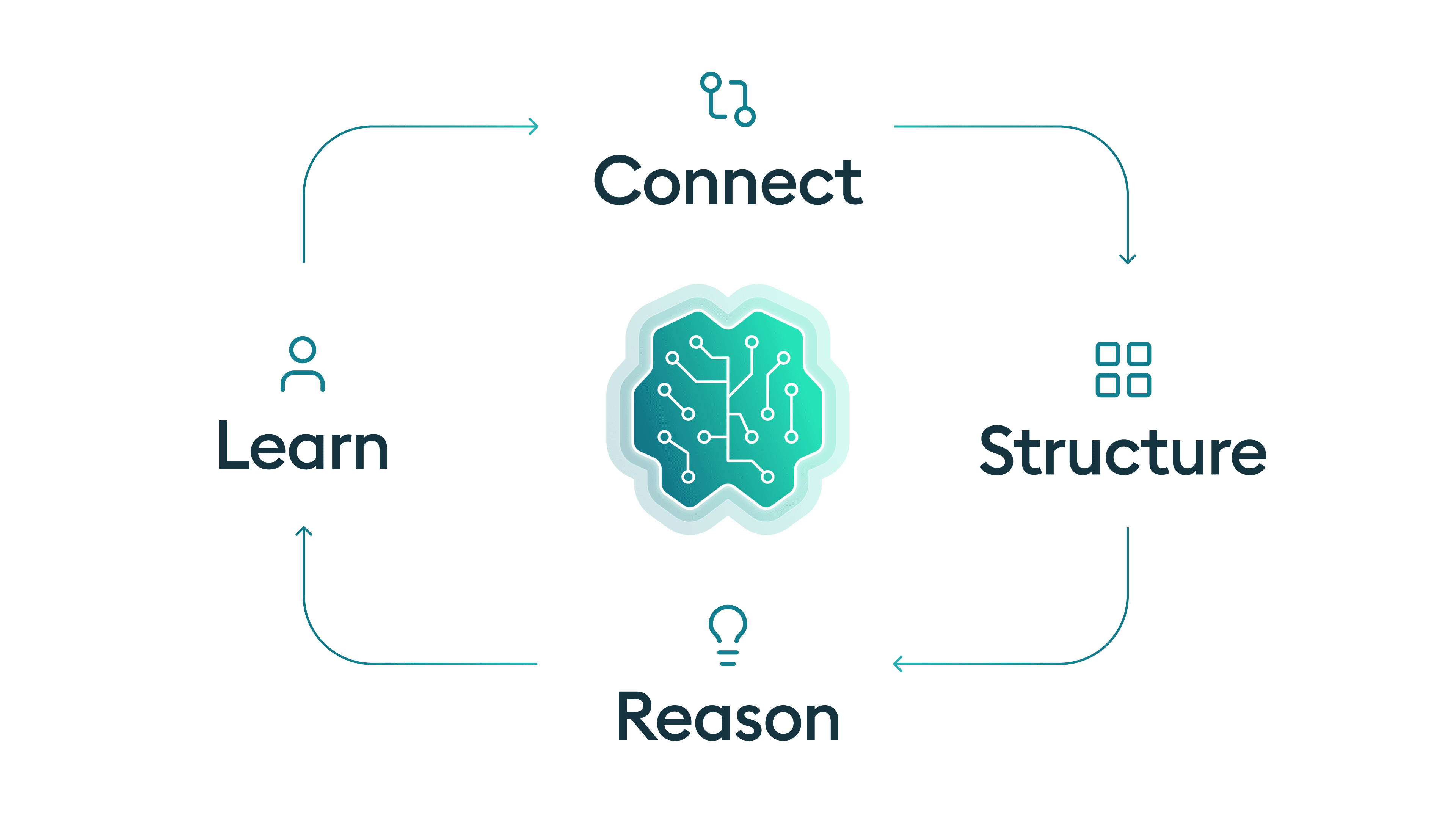
The core of our platform transforms scattered files into a structured knowledge graph through a continuous framework: 

  1. Connect: The platform securely connects enterprise systems such as document repositories, CRM, CLM, DMS tools, spreadsheets, and files through ingestion APIs. Raw data is continuously pulled from where legal and compliance teams already work, ensuring no relevant information is left behind.

  2. Structure: The data is then AI-enriched and structured. Documents are parsed, normalized, and indexed to extract clauses, risks, obligations, entities, and relationships. This transforms unstructured files into structured legal knowledge that machines can process reliably.

  3. Reason: This layer combines AI models, organizational context, institutional knowledge, and memory, and is designed to continuously evolve through usage and feedback. Applications such as Contracts, Compliance, M&A, Litigation, and Insights are powered by this shared Brain, ensuring intelligence compounds across workflows rather than remaining siloed. 

  4. Learn: Human interaction closes the loop. Edits, approvals, overrides, and decisions flow back into the platform, refining models and institutional knowledge over time without sacrificing governance.


The Company Brain: Structured Intelligence for Legal at Enterprise Scale 

The Company Brain is Eudia’s centralized reasoning and memory engine, designed to turn fragmented legal data into structured, context-aware intelligence. Instead of handling tasks or documents in isolation, it continuously ingests information from across the enterprise — including contracts, playbooks, negotiation history, and regulatory frameworks — and organizes it into a dynamic institutional knowledge graph. This allows legal and compliance teams to operate with consistency, traceability, and confidence across complex workflows. 

It addresses the spatial and temporal dimensions of legal knowledge. Spatial memory connects data across systems, helping teams recognize when the vendor being reviewed today was involved in litigation in the past. Temporal memory captures how decisions have evolved over time, remembering not just the standard language in a clause but why it was changed during a previous negotiation with a key partner. 

Technically, the Company Brain combines document structure recognition, intent decomposition, multi-step reasoning, and adaptive memory. It interprets layout, applies organizational norms, and generates explainable, citation-backed outputs. The system improves through structured user feedback, allowing it to learn continuously without compromising governance. 

The result is a significant shift in how legal teams work. Review processes become faster, decisions more consistent, and institutional knowledge more accessible. The Company Brain enables legal and compliance functions to deliver insight and precision at the pace of business. 


Legal Work Lives in Enterprise Systems 

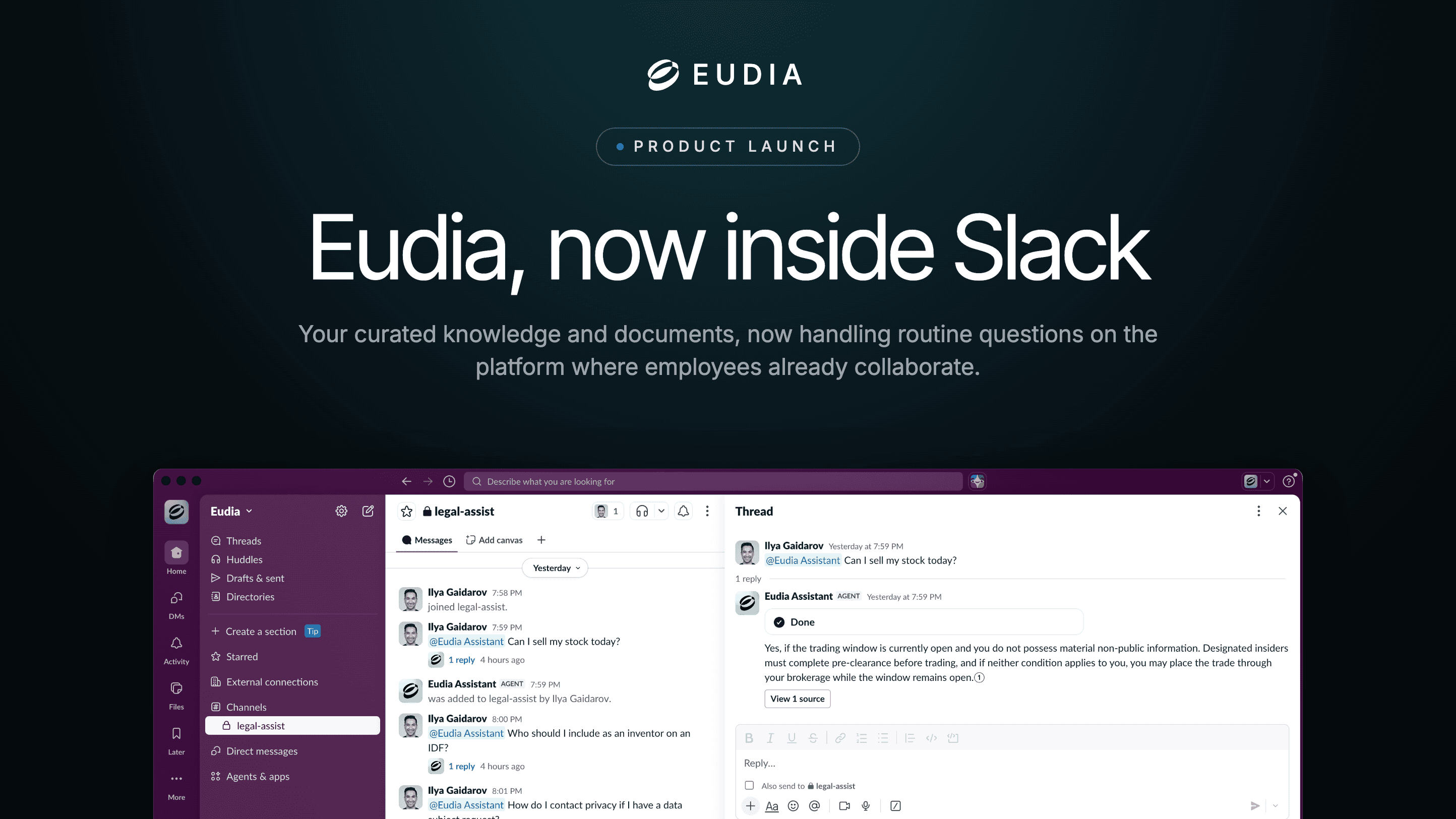
One of the biggest mistakes in legal tech is assuming that lawyers and compliance officers want to log into a separate “legal platform.” They don’t. Their day-to-day work happens in tools like Outlook, Word, and Teams. Meanwhile, their internal clients are operating in Salesforce, ServiceNow, and Slack. 

If legal intelligence is trapped in a standalone portal, it gets overlooked. That’s why Eudia is built as API-first infrastructure, so legal insight can live directly inside the systems where work actually happens. 

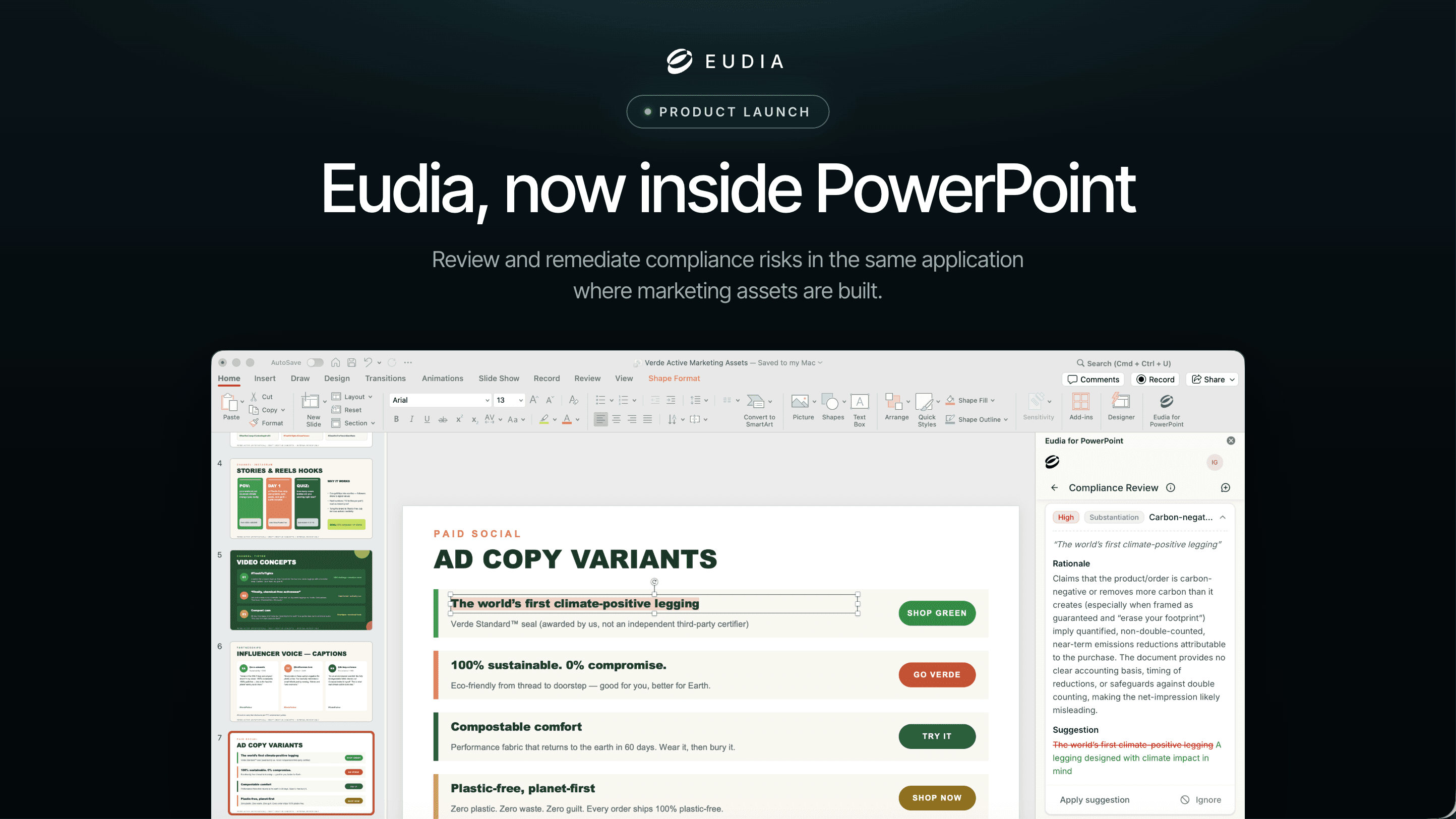
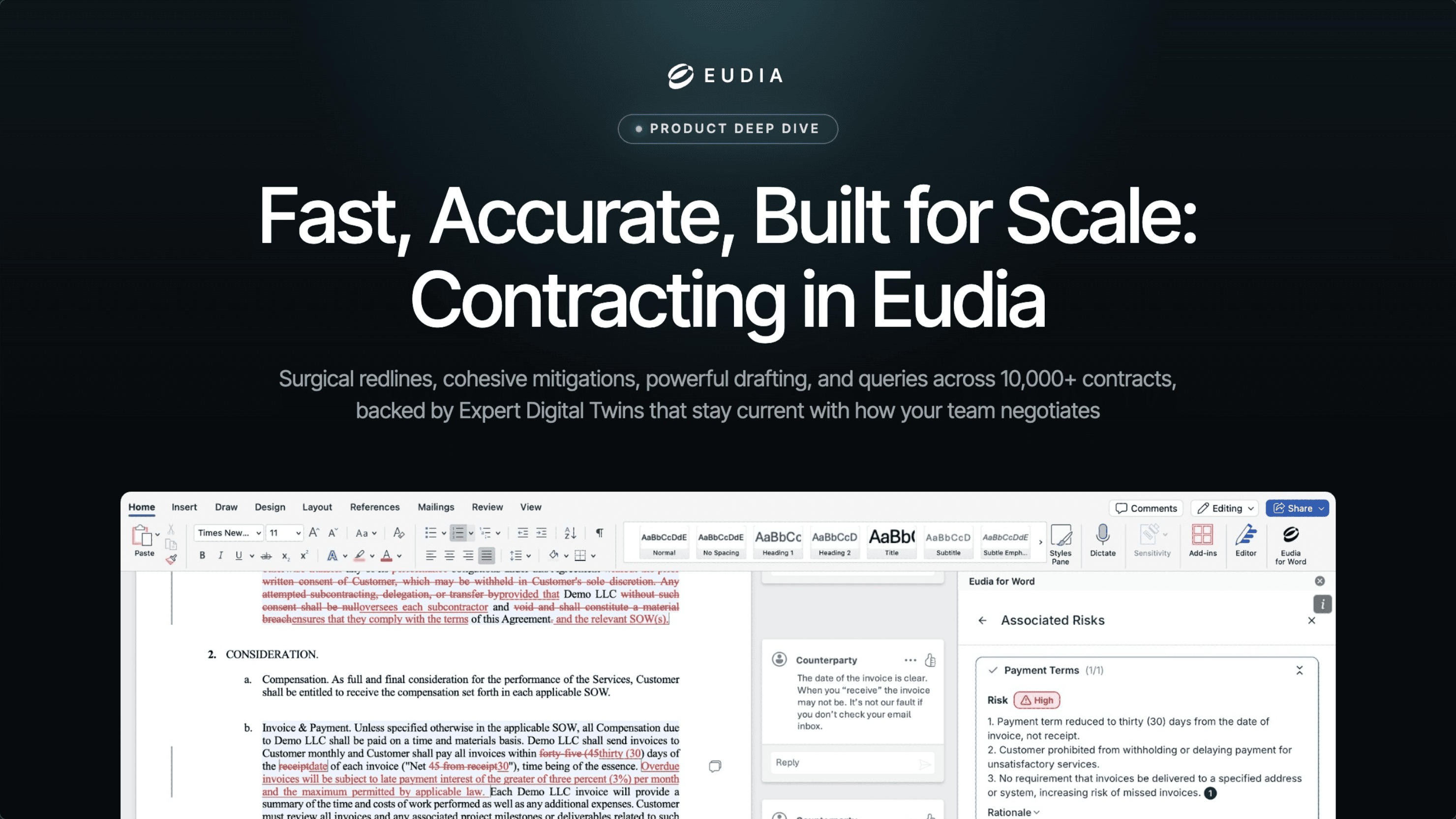
We’re actively working with key enterprise platforms to embed legal intelligence seamlessly into familiar workflows. As an example, Eudia is embedded directly within Word and Outlook. Legal teams get in-context suggestions, clause comparisons, and redlines in the sidebar without leaving the document. Our collaboration with Microsoft Copilot enhances the experience further, providing generative AI-powered recommendations for right where work is happening. 

We also ingest and structure data from Sharepoint, Google Drive, Figma, Ironclad, ONIT, Docusign, iManage, LinkSquares, Salesforce. 

The Ecosystem Multiplier

By delivering intelligence directly within the flow of work, Eudia significantly reduces the burden of change management. There is no new system to learn, only a smarter version of the tools teams already use. 

This approach allows organizations to start with a focused use case, such as resolving a bottleneck in procurement, and expand with confidence. Because the underlying data model is centralized in the Company Brain, new workflows can be deployed without re-architecting the entire technology stack. 

In legal and compliance, this is critical. Even small errors can lead to major regulatory, financial, or reputational risk. That is why CLOs remain cautious about tools that prioritize speed over transparency. With Eudia, every output is grounded in source data and organizational policy, providing clarity, control, and ongoing accountability. 
Legal data is just text to a standard Large Language Model, a contract is just a stream of words. We have been working with CLOs of the most important organizations, and we’ve built a platform that knows a contract is a complex object containing hierarchy, layout, defined terms, and explicit relationships between entities. 

Treating legal documents as flat text destroys their value. Eudia is built on the premise that you must structure the data before it can be understood and analyzed. We parse the document not just for keywords, but for logic - understanding that a limitation of liability clause in section 9 interacts with an indemnity capability in section 4. 

How the Platform Works: The 4-Step Framework

The core of our platform transforms scattered files into a structured knowledge graph through a continuous framework: 

  1. Connect: The platform securely connects enterprise systems such as document repositories, CRM, CLM, DMS tools, spreadsheets, and files through ingestion APIs. Raw data is continuously pulled from where legal and compliance teams already work, ensuring no relevant information is left behind.

  2. Structure: The data is then AI-enriched and structured. Documents are parsed, normalized, and indexed to extract clauses, risks, obligations, entities, and relationships. This transforms unstructured files into structured legal knowledge that machines can process reliably.

  3. Reason: This layer combines AI models, organizational context, institutional knowledge, and memory, and is designed to continuously evolve through usage and feedback. Applications such as Contracts, Compliance, M&A, Litigation, and Insights are powered by this shared Brain, ensuring intelligence compounds across workflows rather than remaining siloed. 

  4. Learn: Human interaction closes the loop. Edits, approvals, overrides, and decisions flow back into the platform, refining models and institutional knowledge over time without sacrificing governance.


The Company Brain: Structured Intelligence for Legal at Enterprise Scale 

The Company Brain is Eudia’s centralized reasoning and memory engine, designed to turn fragmented legal data into structured, context-aware intelligence. Instead of handling tasks or documents in isolation, it continuously ingests information from across the enterprise — including contracts, playbooks, negotiation history, and regulatory frameworks — and organizes it into a dynamic institutional knowledge graph. This allows legal and compliance teams to operate with consistency, traceability, and confidence across complex workflows. 

It addresses the spatial and temporal dimensions of legal knowledge. Spatial memory connects data across systems, helping teams recognize when the vendor being reviewed today was involved in litigation in the past. Temporal memory captures how decisions have evolved over time, remembering not just the standard language in a clause but why it was changed during a previous negotiation with a key partner. 

Technically, the Company Brain combines document structure recognition, intent decomposition, multi-step reasoning, and adaptive memory. It interprets layout, applies organizational norms, and generates explainable, citation-backed outputs. The system improves through structured user feedback, allowing it to learn continuously without compromising governance. 

The result is a significant shift in how legal teams work. Review processes become faster, decisions more consistent, and institutional knowledge more accessible. The Company Brain enables legal and compliance functions to deliver insight and precision at the pace of business. 


Legal Work Lives in Enterprise Systems 

One of the biggest mistakes in legal tech is assuming that lawyers and compliance officers want to log into a separate “legal platform.” They don’t. Their day-to-day work happens in tools like Outlook, Word, and Teams. Meanwhile, their internal clients are operating in Salesforce, ServiceNow, and Slack. 

If legal intelligence is trapped in a standalone portal, it gets overlooked. That’s why Eudia is built as API-first infrastructure, so legal insight can live directly inside the systems where work actually happens. 

We’re actively working with key enterprise platforms to embed legal intelligence seamlessly into familiar workflows. As an example, Eudia is embedded directly within Word and Outlook. Legal teams get in-context suggestions, clause comparisons, and redlines in the sidebar without leaving the document. Our collaboration with Microsoft Copilot enhances the experience further, providing generative AI-powered recommendations for right where work is happening. 

We also ingest and structure data from Sharepoint, Google Drive, Figma, Ironclad, ONIT, Docusign, iManage, LinkSquares, Salesforce. 


The Ecosystem Multiplier

By delivering intelligence directly within the flow of work, Eudia significantly reduces the burden of change management. There is no new system to learn, only a smarter version of the tools teams already use. 

This approach allows organizations to start with a focused use case, such as resolving a bottleneck in procurement, and expand with confidence. Because the underlying data model is centralized in the Company Brain, new workflows can be deployed without re-architecting the entire technology stack. 

In legal and compliance, this is critical. Even small errors can lead to major regulatory, financial, or reputational risk. That is why CLOs remain cautious about tools that prioritize speed over transparency. With Eudia, every output is grounded in source data and organizational policy, providing clarity, control, and ongoing accountability. 

Legal data is just text to a standard Large Language Model, a contract is just a stream of words. We have been working with CLOs of the most important organizations, and we’ve built a platform that knows a contract is a complex object containing hierarchy, layout, defined terms, and explicit relationships between entities. 

Treating legal documents as flat text destroys their value. Eudia is built on the premise that you must structure the data before it can be understood and analyzed. We parse the document not just for keywords, but for logic - understanding that a limitation of liability clause in section 9 interacts with an indemnity capability in section 4. 

How the Platform Works: The 4-Step Framework

The core of our platform transforms scattered files into a structured knowledge graph through a continuous framework: 

  1. Connect: The platform securely connects enterprise systems such as document repositories, CRM, CLM, DMS tools, spreadsheets, and files through ingestion APIs. Raw data is continuously pulled from where legal and compliance teams already work, ensuring no relevant information is left behind.

  2. Structure: The data is then AI-enriched and structured. Documents are parsed, normalized, and indexed to extract clauses, risks, obligations, entities, and relationships. This transforms unstructured files into structured legal knowledge that machines can process reliably.

  3. Reason: This layer combines AI models, organizational context, institutional knowledge, and memory, and is designed to continuously evolve through usage and feedback. Applications such as Contracts, Compliance, M&A, Litigation, and Insights are powered by this shared Brain, ensuring intelligence compounds across workflows rather than remaining siloed. 

  4. Learn: Human interaction closes the loop. Edits, approvals, overrides, and decisions flow back into the platform, refining models and institutional knowledge over time without sacrificing governance.


The Company Brain: Structured Intelligence for Legal at Enterprise Scale 

The Company Brain is Eudia’s centralized reasoning and memory engine, designed to turn fragmented legal data into structured, context-aware intelligence. Instead of handling tasks or documents in isolation, it continuously ingests information from across the enterprise — including contracts, playbooks, negotiation history, and regulatory frameworks — and organizes it into a dynamic institutional knowledge graph. This allows legal and compliance teams to operate with consistency, traceability, and confidence across complex workflows. 

It addresses the spatial and temporal dimensions of legal knowledge. Spatial memory connects data across systems, helping teams recognize when the vendor being reviewed today was involved in litigation in the past. Temporal memory captures how decisions have evolved over time, remembering not just the standard language in a clause but why it was changed during a previous negotiation with a key partner. 

Technically, the Company Brain combines document structure recognition, intent decomposition, multi-step reasoning, and adaptive memory. It interprets layout, applies organizational norms, and generates explainable, citation-backed outputs. The system improves through structured user feedback, allowing it to learn continuously without compromising governance. 

The result is a significant shift in how legal teams work. Review processes become faster, decisions more consistent, and institutional knowledge more accessible. The Company Brain enables legal and compliance functions to deliver insight and precision at the pace of business. 


Legal Work Lives in Enterprise Systems 

One of the biggest mistakes in legal tech is assuming that lawyers and compliance officers want to log into a separate “legal platform.” They don’t. Their day-to-day work happens in tools like Outlook, Word, and Teams. Meanwhile, their internal clients are operating in Salesforce, ServiceNow, and Slack. 

If legal intelligence is trapped in a standalone portal, it gets overlooked. That’s why Eudia is built as API-first infrastructure, so legal insight can live directly inside the systems where work actually happens. 

We’re actively working with key enterprise platforms to embed legal intelligence seamlessly into familiar workflows. As an example, Eudia is embedded directly within Word and Outlook. Legal teams get in-context suggestions, clause comparisons, and redlines in the sidebar without leaving the document. Our collaboration with Microsoft Copilot enhances the experience further, providing generative AI-powered recommendations for right where work is happening. 

We also ingest and structure data from Sharepoint, Google Drive, Figma, Ironclad, ONIT, Docusign, iManage, LinkSquares, Salesforce. 


The Ecosystem Multiplier

By delivering intelligence directly within the flow of work, Eudia significantly reduces the burden of change management. There is no new system to learn, only a smarter version of the tools teams already use. 

This approach allows organizations to start with a focused use case, such as resolving a bottleneck in procurement, and expand with confidence. Because the underlying data model is centralized in the Company Brain, new workflows can be deployed without re-architecting the entire technology stack. 

In legal and compliance, this is critical. Even small errors can lead to major regulatory, financial, or reputational risk. That is why CLOs remain cautious about tools that prioritize speed over transparency. With Eudia, every output is grounded in source data and organizational policy, providing clarity, control, and ongoing accountability.