Beyond the DOCX & PDF: Expanding the Horizons of Legal AI with Multimodal Agentic Content AI

Jan 29, 2026

|

Blog

Ashish Agrawal and Coleman Monroe

For decades, "Legal Tech" has been synonymous with text processing. The mental image is always the same: a lawyer reviewing a contract, a paralegal scanning a PDF, or an algorithm parsing a Word document.

But modern in-house legal teams don't just live in documents. They live in the messy, unstructured reality of the modern enterprise. Risk doesn't just hide in Clause 4 of a contract; it hides in a casual email attachment, a regulatory slip-up during a recorded Zoom meeting, or a non-compliant frame in a 30-second marketing video.

At Eudia, we believe that for an AI to truly protect an organization, it must be able to see, hear, and read everything the organization produces. We have further expanded our Multimodal Agentic Content AI pipeline to support native Email, Image, Audio, and Video processing, backed by a new high-performance ML infrastructure.

Here is how we are building the first truly multimodal knowledge engine for legal teams.


The Inbox is the New Filing Cabinet: Native Email Parsing

Emails have historically been a headache for legal engineering. The industry standard "hack" is to convert every email (.eml or .msg) into a PDF and then run OCR on it. This is inefficient, slow, and loses critical metadata.

We have fundamentally re-architected how we handle correspondence by implementing native email parsing in our backend.

1. Recursion & Attachments

The biggest blind spot in email processing is usually the attachment. By parsing the raw email structure rather than flattening it to an image, we can now capture and process attachments independently.

When our system ingests an email, it triggers Agentic Content AI pipeline in recursive manner. The email body is processed for context, while the attachments (spreadsheets, contracts, decks) are spun off into their own processing threads. It enables deep indexing and agentic execution. You can now search for a specific clause in a contract that was attached to an email sent three years ago, and the system understands the relationship between the message and the file.

2. Speed & Efficiency

Text is lightweight; PDFs are heavy. by skipping the conversion step, we have drastically reduced memory usage and increased processing speeds for simple emails. This allows us to ingest massive email dumps (common in discovery) at a fraction of the compute cost.

Seeing and Hearing Risk: Audio & Video Intelligence

The volume of corporate audio and video data is exploding, yet it remains largely "dark data" to legal teams because it is unsearchable. We have integrated advanced Audio and Video processing directly into our ingestion pipeline to turn this media into structured data.


Audio: Audio carries emotion, not just information

We implemented a robust transcription pipeline that serves as the foundation for several new features in our Sigma platform:

  • Q&A on Audio: Users can now ask natural language questions against audio files. Imagine asking, "Did the sales representative mention a guaranteed ROI in this call?" and getting an answer based on the transcript.

  • Compliance Monitoring: We can now run our standard compliance guardrails over audio files, flagging risky language or policy violations in recorded calls.

  • Text-to-Speech (TTS): We’ve closed the loop by adding TTS capabilities, allowing for more interactive accessibility features within the product.

Video: A picture is worth a thousand words. A video is a thousand pictures in motion.

Video is the ultimate challenge for ingestion. A 5-minute marketing video contains thousands of frames of visual information and a synchronized audio track.

Our new video pipeline processes content in two parallel streams:

  1. The Transcript: We extract the audio track to generate a text transcript with associated speakers, enabling search and semantic analysis of the spoken content.

  2. Visual Understanding: We select frames uniformly across the video length and pass them through image understanding models. This generates scene descriptions and identifies embedded text (OCR) within the video frames themselves.

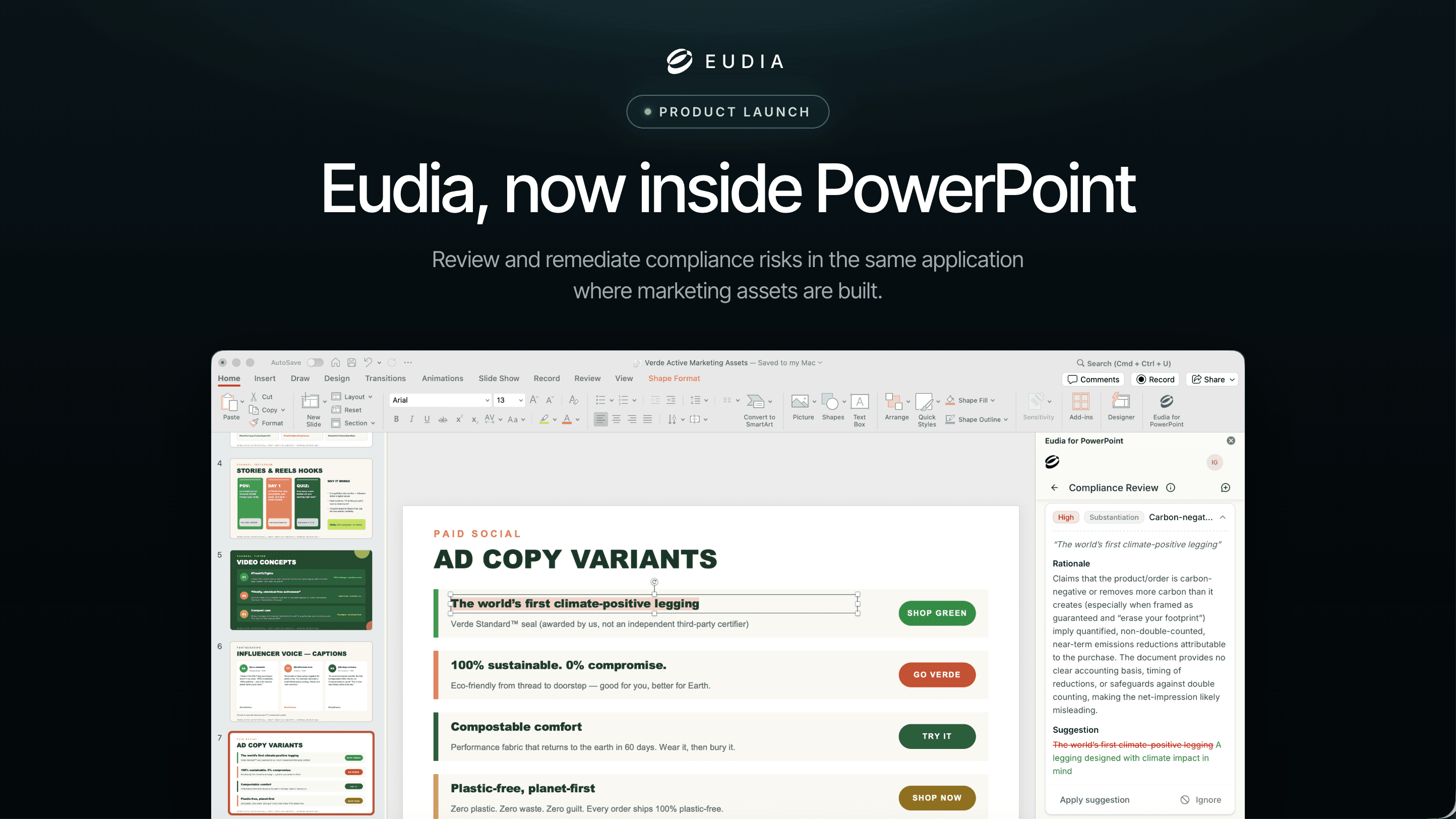
The Production Win: This isn't just research: it’s live. Our customers are already benefiting from Marketing Compliance Risk Identification for videos. Our system can now watch a draft commercial and flag if a disclaimer is missing from the bottom of the screen or if a visual claim contradicts the audio track through a joint learning of audio and visual components over the sequence.

Why This Matters

The definition of a "document" is evolving. If a legal team only reviews PDFs, they are missing half the story.

By adding native email, audio, and video modalities, and backing them with a robust, proprietary infrastructure, we are ensuring that Eudia remains the most comprehensive source of truth for in-house legal teams. Whether it’s a contract, a voicemail, or a Super Bowl ad, our platform is ready to read, watch, and protect.

Interested in solving the world’s hardest AI and engineering problems? Eudia Careers —we’re hiring.


For decades, "Legal Tech" has been synonymous with text processing. The mental image is always the same: a lawyer reviewing a contract, a paralegal scanning a PDF, or an algorithm parsing a Word document.

But modern in-house legal teams don't just live in documents. They live in the messy, unstructured reality of the modern enterprise. Risk doesn't just hide in Clause 4 of a contract; it hides in a casual email attachment, a regulatory slip-up during a recorded Zoom meeting, or a non-compliant frame in a 30-second marketing video.

At Eudia, we believe that for an AI to truly protect an organization, it must be able to see, hear, and read everything the organization produces. We have further expanded our Multimodal Agentic Content AI pipeline to support native Email, Image, Audio, and Video processing, backed by a new high-performance ML infrastructure.

Here is how we are building the first truly multimodal knowledge engine for legal teams.


The Inbox is the New Filing Cabinet: Native Email Parsing

Emails have historically been a headache for legal engineering. The industry standard "hack" is to convert every email (.eml or .msg) into a PDF and then run OCR on it. This is inefficient, slow, and loses critical metadata.

We have fundamentally re-architected how we handle correspondence by implementing native email parsing in our backend.

1. Recursion & Attachments

The biggest blind spot in email processing is usually the attachment. By parsing the raw email structure rather than flattening it to an image, we can now capture and process attachments independently.

When our system ingests an email, it triggers Agentic Content AI pipeline in recursive manner. The email body is processed for context, while the attachments (spreadsheets, contracts, decks) are spun off into their own processing threads. It enables deep indexing and agentic execution. You can now search for a specific clause in a contract that was attached to an email sent three years ago, and the system understands the relationship between the message and the file.

2. Speed & Efficiency

Text is lightweight; PDFs are heavy. by skipping the conversion step, we have drastically reduced memory usage and increased processing speeds for simple emails. This allows us to ingest massive email dumps (common in discovery) at a fraction of the compute cost.

Seeing and Hearing Risk: Audio & Video Intelligence

The volume of corporate audio and video data is exploding, yet it remains largely "dark data" to legal teams because it is unsearchable. We have integrated advanced Audio and Video processing directly into our ingestion pipeline to turn this media into structured data.


Audio: Audio carries emotion, not just information

We implemented a robust transcription pipeline that serves as the foundation for several new features in our Sigma platform:

  • Q&A on Audio: Users can now ask natural language questions against audio files. Imagine asking, "Did the sales representative mention a guaranteed ROI in this call?" and getting an answer based on the transcript.

  • Compliance Monitoring: We can now run our standard compliance guardrails over audio files, flagging risky language or policy violations in recorded calls.

  • Text-to-Speech (TTS): We’ve closed the loop by adding TTS capabilities, allowing for more interactive accessibility features within the product.

Video: A picture is worth a thousand words. A video is a thousand pictures in motion.

Video is the ultimate challenge for ingestion. A 5-minute marketing video contains thousands of frames of visual information and a synchronized audio track.

Our new video pipeline processes content in two parallel streams:

  1. The Transcript: We extract the audio track to generate a text transcript with associated speakers, enabling search and semantic analysis of the spoken content.

  2. Visual Understanding: We select frames uniformly across the video length and pass them through image understanding models. This generates scene descriptions and identifies embedded text (OCR) within the video frames themselves.

The Production Win: This isn't just research: it’s live. Our customers are already benefiting from Marketing Compliance Risk Identification for videos. Our system can now watch a draft commercial and flag if a disclaimer is missing from the bottom of the screen or if a visual claim contradicts the audio track through a joint learning of audio and visual components over the sequence.

Why This Matters

The definition of a "document" is evolving. If a legal team only reviews PDFs, they are missing half the story.

By adding native email, audio, and video modalities, and backing them with a robust, proprietary infrastructure, we are ensuring that Eudia remains the most comprehensive source of truth for in-house legal teams. Whether it’s a contract, a voicemail, or a Super Bowl ad, our platform is ready to read, watch, and protect.

Interested in solving the world’s hardest AI and engineering problems? Eudia Careers —we’re hiring.


For decades, "Legal Tech" has been synonymous with text processing. The mental image is always the same: a lawyer reviewing a contract, a paralegal scanning a PDF, or an algorithm parsing a Word document.

But modern in-house legal teams don't just live in documents. They live in the messy, unstructured reality of the modern enterprise. Risk doesn't just hide in Clause 4 of a contract; it hides in a casual email attachment, a regulatory slip-up during a recorded Zoom meeting, or a non-compliant frame in a 30-second marketing video.

At Eudia, we believe that for an AI to truly protect an organization, it must be able to see, hear, and read everything the organization produces. We have further expanded our Multimodal Agentic Content AI pipeline to support native Email, Image, Audio, and Video processing, backed by a new high-performance ML infrastructure.

Here is how we are building the first truly multimodal knowledge engine for legal teams.


The Inbox is the New Filing Cabinet: Native Email Parsing

Emails have historically been a headache for legal engineering. The industry standard "hack" is to convert every email (.eml or .msg) into a PDF and then run OCR on it. This is inefficient, slow, and loses critical metadata.

We have fundamentally re-architected how we handle correspondence by implementing native email parsing in our backend.

1. Recursion & Attachments

The biggest blind spot in email processing is usually the attachment. By parsing the raw email structure rather than flattening it to an image, we can now capture and process attachments independently.

When our system ingests an email, it triggers Agentic Content AI pipeline in recursive manner. The email body is processed for context, while the attachments (spreadsheets, contracts, decks) are spun off into their own processing threads. It enables deep indexing and agentic execution. You can now search for a specific clause in a contract that was attached to an email sent three years ago, and the system understands the relationship between the message and the file.

2. Speed & Efficiency

Text is lightweight; PDFs are heavy. by skipping the conversion step, we have drastically reduced memory usage and increased processing speeds for simple emails. This allows us to ingest massive email dumps (common in discovery) at a fraction of the compute cost.

Seeing and Hearing Risk: Audio & Video Intelligence

The volume of corporate audio and video data is exploding, yet it remains largely "dark data" to legal teams because it is unsearchable. We have integrated advanced Audio and Video processing directly into our ingestion pipeline to turn this media into structured data.


Audio: Audio carries emotion, not just information

We implemented a robust transcription pipeline that serves as the foundation for several new features in our Sigma platform:

  • Q&A on Audio: Users can now ask natural language questions against audio files. Imagine asking, "Did the sales representative mention a guaranteed ROI in this call?" and getting an answer based on the transcript.

  • Compliance Monitoring: We can now run our standard compliance guardrails over audio files, flagging risky language or policy violations in recorded calls.

  • Text-to-Speech (TTS): We’ve closed the loop by adding TTS capabilities, allowing for more interactive accessibility features within the product.

Video: A picture is worth a thousand words. A video is a thousand pictures in motion.

Video is the ultimate challenge for ingestion. A 5-minute marketing video contains thousands of frames of visual information and a synchronized audio track.

Our new video pipeline processes content in two parallel streams:

  1. The Transcript: We extract the audio track to generate a text transcript with associated speakers, enabling search and semantic analysis of the spoken content.

  2. Visual Understanding: We select frames uniformly across the video length and pass them through image understanding models. This generates scene descriptions and identifies embedded text (OCR) within the video frames themselves.

The Production Win: This isn't just research: it’s live. Our customers are already benefiting from Marketing Compliance Risk Identification for videos. Our system can now watch a draft commercial and flag if a disclaimer is missing from the bottom of the screen or if a visual claim contradicts the audio track through a joint learning of audio and visual components over the sequence.

Why This Matters

The definition of a "document" is evolving. If a legal team only reviews PDFs, they are missing half the story.

By adding native email, audio, and video modalities, and backing them with a robust, proprietary infrastructure, we are ensuring that Eudia remains the most comprehensive source of truth for in-house legal teams. Whether it’s a contract, a voicemail, or a Super Bowl ad, our platform is ready to read, watch, and protect.

Interested in solving the world’s hardest AI and engineering problems? Eudia Careers —we’re hiring.