" height="21.74796186902578px" id="t3MdhTE9r" transform="translate(0 0)" width="90.99999762294988px"/></g></svg>)
The Enterprise Brain
Blog
Our Approach to Contracting

Ashish Agrawal
Co-founder & CTO

Share
In the rush to adopt Generative AI, the legal industry has been flooded with tools that appear impressive but are dangerous in execution. We've all seen the demos: you upload a contract, ask for a "friendly review," and the AI regurgitates a wall of text that is technically correct but practically unusable. It changes definitions that didn't need changing, it adopts a robotic tone, and it ignores the cascading effects that a single edit in Section 2 has on the indemnity cap in Section 14.
At Eudia, we realized early on that treating a contract like a linear string of text, the way a standard Large Language Model (LLM) treats a poem or an essay, is a category error. A contract is not just text; it is a logic system. It is a compilation of dependencies, risks, and leverage.
To solve this, we engineered a Holistic Negotiation Agent.
As CTO, I want to pull back the curtain on how we are tackling the complex engineering task of automated negotiation. We moved away from generative LLM drafting toward what we call Surgical Redlining. Here is how we built it.
Contracts as Logical Graphs, Not Pages
The biggest failure mode of current legal AI is "tunnel vision." Standard models analyze text sequentially. They identify a risky paragraph and attempt to fix it in isolation.
The problem is that in complex commercial agreements, fixing a paragraph in isolation often breaks the deal structure elsewhere.
At Eudia, we treat the document as an interconnected web of risks and clauses. We utilize Bipartite Graph Clustering to map the relationships between every clause and every identified risk across the entire contract.
Instead of optimizing for a local improvement (making a single sentence better), our engine solves for the Global Optimum. It asks: What combination of changes maximizes protection while minimizing red ink?
This leads to our philosophy of Minimalist Intervention. Lawyers know that the fastest way to kill a deal is to send back a document that is 80% redlines. Our system consolidates multiple risks into the fewest possible edits. It is surgical. It touches only what matters, leaving the rest of the document's integrity, and the counterparty's patience, intact.
Solving the Tone Problem via Style Transfer
High-quality legal drafting has a distinct tone: precise, neutral and authoritative. It is precise, neutral, and authoritative. Standard AI models, however, struggle to replicate this and tend to be chatty, apologetic, or overtly robotic.
For Eudia, this wasn't acceptable. If lawyers have to rewrite AI-generated redlines to make them sound right, the value disappears.
That's why we implemented rigorous Style Transfer protocols governed by our proprietary "Redline Editorial Guidelines." These guidelines were not hallucinated by a model; they were iterated through feedback from direct users and seasoned attorneys.
Crucially, this system is not static. We engineered a continuous learning loop that digests both:
Explicit feedback (direct playbook adjustments), and
Implicit signals (observing which redlines you accept, reject, or modify).
This feedback doesn't just vanish; it dynamically refines your organization's Playbook. As you work, Eudia learns your specific negotiation nuances, ensuring that every subsequent AI review is more aligned with your risk tolerance and drafting style than the last.
The result is attorney-quality language that feels native to the user. When Eudia suggests a redline, it doesn't look like a suggestion from a chatbot; it looks like a redline from the user themselves. The highest compliment and most consistent feedback we receive during our initial rollouts is "this is starting to sound like me."
Working Within Microsoft Word
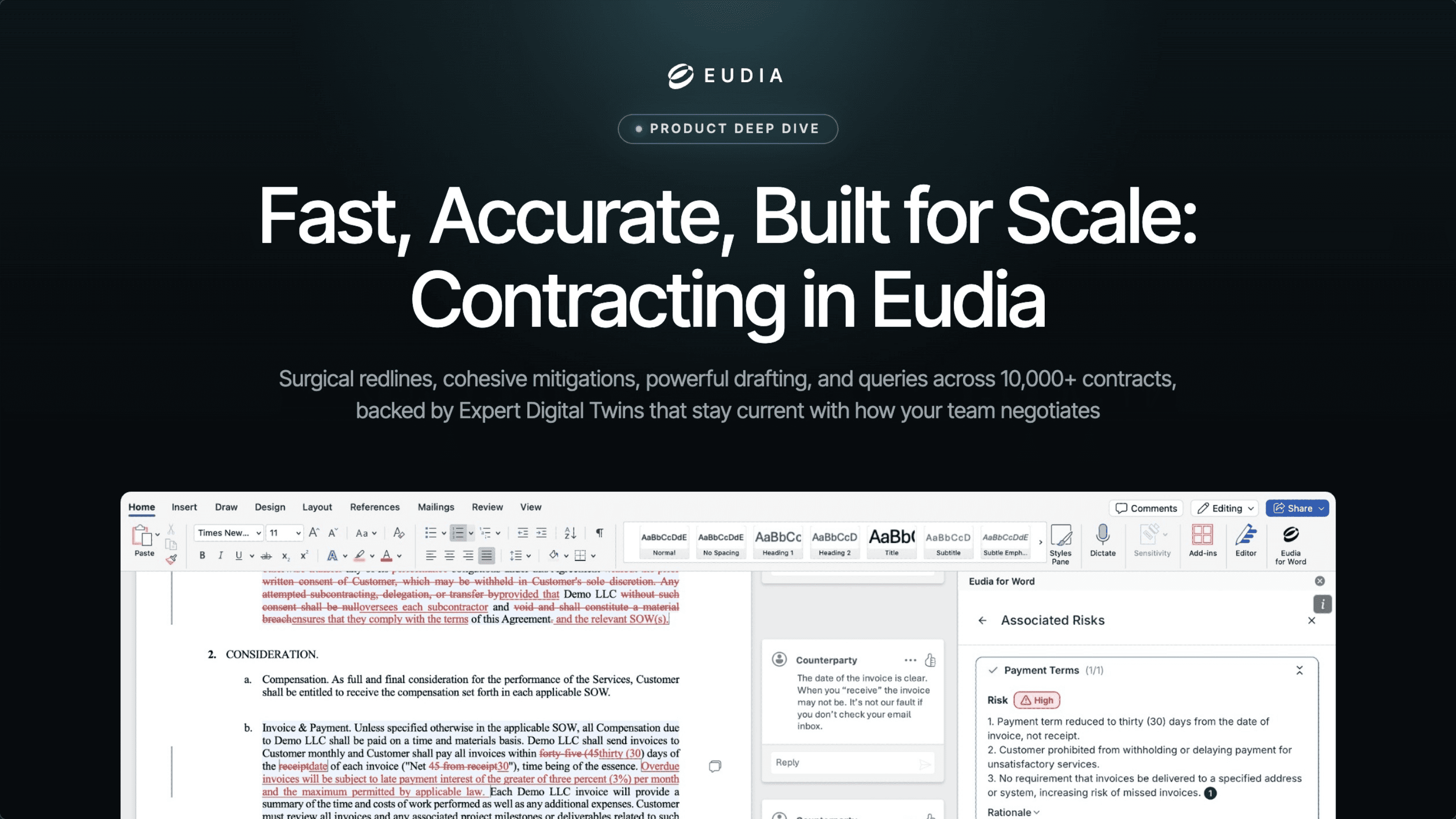
While style and logic are vital, the actual mechanics of a Word document are notoriously difficult for AI to handle. Microsoft Word utilizes a complex Office Open XML (OOXML) structure to render documents. Others have argued that manipulating OOXML through LLMs is too difficult or impossible, resulting in tools that strip formatting or break document integrity.
However, we discovered that while LLMs struggle to generate raw OOXML directly, they are excellent at logic mapping. We engineered a proprietary method to translate complex OOXML into a "minimalist representation" that the LLM can understand and manipulate. Once the AI performs its surgical edits, our system reconstructs the full OOXML structure without data loss.
This "translation layer" allows us to do things that were previously impossible:
Redlines over Redlines: We don't just handle clean documents. Our system can handle subsequent reviews, layering new redlines over existing redlines without breaking the document history or losing a single edit, bold tag, or italicization.
Comment Interaction: We go beyond text edits. Eudia can insert new comments and crucially, read and reply to existing comments within the document metadata.
Drafting with Integrity: We are actively rolling out the ability to draft documents from scratch while preserving complex formatting hierarchies, such as bullet points and indentation (formatting preservation is currently in active development).
Crucially, these capabilities are not limited to pre-defined workflows. Because we have cracked the underlying code structure, these features can be triggered dynamically through Ask AI, giving you granular control over the document's DNA via natural language.
Illuminating the Black Box
The legal industry cannot tolerate a "black box." If an AI suggests a fallback position, you need to know why, and you need to be sure it aligns with your company's risk appetite.
We engineered a system of Structured Intelligence based on deterministic reasoning.
Playbook Logic: We don't let the AI guess your risk tolerance. We anchor the model to a structured hierarchy of positions (Preferred ? Pushback ? Fallback). This allows our users to modulate risk tolerance granularly. You can tell Eudia to be aggressive on IP but conciliatory on Payment Terms.
Chain-of-Thought (CoT) Verification: We utilize detailed Chain-of-Thought context engineering to enforce consistent reasoning. Before the model writes a single word of a redline, it must generate a reasoning step explaining its logic. This ensures the output adheres to the playbook and provides a reproducible audit trail.
We don't just give you the what; we give you the why.
The Agent Layer: From Drafter to Negotiator
Perhaps the most exciting frontier we are crossing is the shift from passive drafting to active Negotiation Automation.
A human lawyer doesn't just read a contract; they read the other lawyer. They notice patterns. "Opposing counsel always strikes the non-solicit but yields on the liability cap."
We are building that intuition into Eudia.
Counterparty Pattern Analysis: By tracking author sessions, our system builds a profile of the opposing counsel. It identifies negotiation tendencies and patterns, allowing you to strategize based on who is on the other side of the table.
Auto-Negotiation & Persuasion: Eudia can execute "Auto Accept/Reject" workflows on incoming redlines (redline-over-redline). But crucially, it doesn't just reject a change; it argues it. The agent generates persuasive comments to justify rejections, mimicking the soft skills of a human lawyer to move the negotiation forward without picking up the phone.
Data-Driven Bootstrapping: Finally, we are solving the "cold start" problem. Our system paves the path for data-driven recommendations by analyzing your past negotiations and executed contracts. Eudia gets smarter with every deal you close.
The Future is Personalized & Surgical
At Eudia, we believe that the future of legal tech isn't about replacing lawyers; it's about removing the friction from their most high-value work.
By combining graph theory, style transfer, and agentic workflows, we aren't just summarizing documents. We are providing a surgical instrument for the modern negotiator, precise, risk-aware, and relentlessly focused on getting to "yes."
Welcome to the era of the Holistic Negotiation Agent.