The End of LLM Wrappers: Why Context, Trust, and Institutional Knowledge Will Win
Feb 6, 2026
|
Blog
Omar Haroun
Co-Founder & CEO

This week, Anthropic released its legal plug-in, and the market responded immediately. More than $1 trillion in software and services market cap was wiped out overnight. LegalZoom dropped sharply. Legal and information powerhouses like Thomson Reuters, RELX, and Wolters Kluwer took major hits. If there were public tickers for private legal tech companies built on language models, you would likely see the same repricing.
At Eudia, we have built something fundamentally different: an augmented intelligence platform for in-house legal teams that turns institutional knowledge into defensible infrastructure. Here is why the $1 trillion wipeout validates our approach.
This Isn’t About Claude, and It Isn’t Really About Legal
What just happened signals the next phase of generative AI’s evolution, one that challenges the core business models of a recent generation of AI-native companies.
For the past two to three years, it made perfect sense to build a company wrapped around a foundation model. Take a general-purpose LLM, add a user interface, embed some workflow logic and prompt engineering, and sell it as “ChatGPT for X.”
It worked. Companies like Jasper (marketing content), Cursor (coding assistant), and others raised billions with this approach. Customers were wowed by how quickly these tools improved, largely because the foundation models beneath them kept getting better.
For industries historically underserved by software, including legal, finance, and compliance, these wrappers created real value quickly. But they also created a false impression: that the wrapper itself was the magic, when in reality the underlying model was.
From day one, we bet on a different future.
We believed foundation model providers (OpenAI, Anthropic, Google) would eventually release their own vertical applications. And when they did, shallow wrapper companies would lose pricing power overnight.
That is what we are watching unfold now.
Augmented Intelligence for In-House Legal Teams
Eudia is an augmented intelligence platform built specifically for in-house legal teams. Unlike traditional legal AI tools that simply provide access to language models, we capture and scale institutional legal judgment through proprietary knowledge infrastructure.
That difference matters.
Once foundation model providers enter a vertical directly, customers ask a simple question: Why am I paying a markup for a slightly customized interface when I can go to the source for 90% of the value, at a fraction of the cost?
This moment is a reset. And it points to a deeper truth.
Customers now understand that AI products built purely on access are structurally limited. The next wave of winners will not just deliver access to language models. They will turn knowledge into infrastructure. They will deliver concrete, defensible outcomes built on proprietary data, context, and trust.
Why In-House Legal Teams Need Augmented Intelligence, Not Just Legal AI
At Eudia, this has been our focus from the beginning. We set out to understand what cannot be automated, and what must be protected at all costs inside the enterprise.
The answer is trust.
And in legal, the person who owns that trust, along with the data and the budget, is the Chief Legal Officer. So we built for them.
We did not start by building a chatbot. We built a private, secure data and knowledge platform, and aligned our incentives with customers by selling outcomes instead of seats or hours.
Our thesis has always been simple: the highest-leverage source of value in legal is institutional judgment.
But for most organizations, that judgment is fragmented. It lives across backchannels, unstructured documents, tribal knowledge, and mental models that no one has ever effectively codified.
Foundation models do not have access to this. Public data does not include it. That is why so many legal AI tools built on generic information are plateauing. They can generate plausible answers, but they cannot reflect how your organization actually makes decisions about risk.
The Company Brain: How Eudia Works
Eudia is designed to solve this.
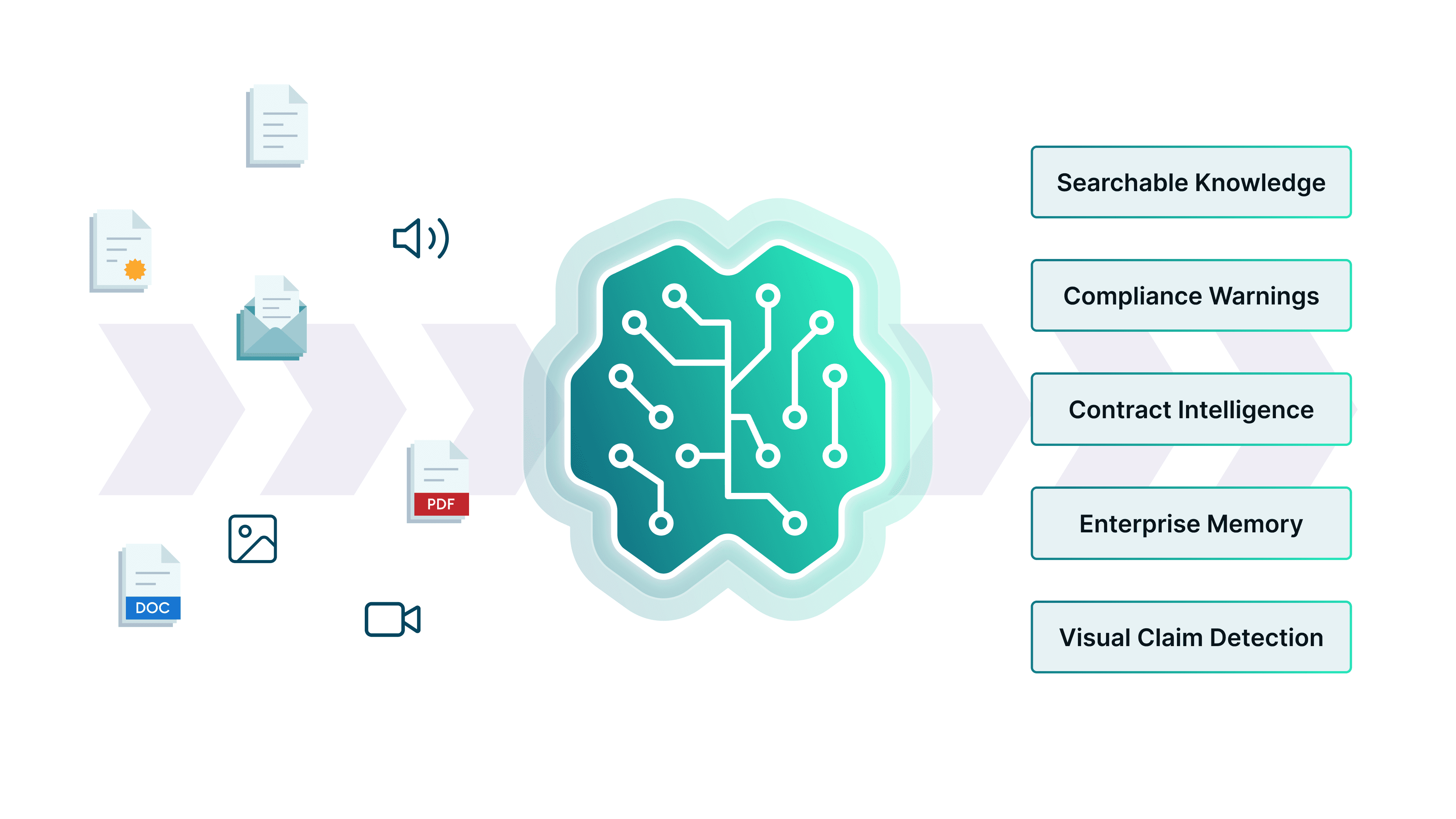
The ‘Company Brain’ is our central knowledge platform that captures how your organization thinks, and the “why” behind it. That includes risk tolerances, exception logic, deal history, precedent, feedback loops, and context that lives outside of traditional legal databases.
Here's what that looks like in practice:
For contract review, Eudia does not just flag standard clauses. It applies your company’s specific risk framework and historical exception patterns.
When evaluating M&A risk, the platform references your past deals, board-level risk tolerances, and undocumented precedents that exist nowhere else.
For policy questions, it surfaces how your team has actually made decisions, not how a generic legal AI thinks you should decide.
We go deep. We do the integration work most companies avoid, because it is what is required to deliver outcomes at scale.
Customers that invest in building the Company Brain that Eudia powers see a step-change in quality, speed, and defensibility.
They are not stuck managing six disconnected tools that do not talk to each other. They are scaling judgment at the core of the business.
And we do not sell software seats. We sell outcomes.
What Separates AI Platforms From AI Wrappers
As AI-native companies get repriced by the market, the split is becoming obvious.
The commodity tools are falling because customers know they can replicate 90% of their value using Anthropic directly.
But the platforms focused on high-context data, deep institutional knowledge, and decision trust, those are ascending.
That is where value is accruing. And that is where we have staked our position.
This shift has been building for some time. Now it is fully visible.
Wrappers are out. Context is the moat.
And the companies bold enough to align with real customer outcomes, including business models built on trust, will define the next decade of this market.
This week, Anthropic released its legal plug-in, and the market responded immediately. More than $1 trillion in software and services market cap was wiped out overnight. LegalZoom dropped sharply. Legal and information powerhouses like Thomson Reuters, RELX, and Wolters Kluwer took major hits. If there were public tickers for private legal tech companies built on language models, you would likely see the same repricing.
At Eudia, we have built something fundamentally different: an augmented intelligence platform for in-house legal teams that turns institutional knowledge into defensible infrastructure. Here is why the $1 trillion wipeout validates our approach.
This Isn’t About Claude, and It Isn’t Really About Legal
What just happened signals the next phase of generative AI’s evolution, one that challenges the core business models of a recent generation of AI-native companies.
For the past two to three years, it made perfect sense to build a company wrapped around a foundation model. Take a general-purpose LLM, add a user interface, embed some workflow logic and prompt engineering, and sell it as “ChatGPT for X.”
It worked. Companies like Jasper (marketing content), Cursor (coding assistant), and others raised billions with this approach. Customers were wowed by how quickly these tools improved, largely because the foundation models beneath them kept getting better.
For industries historically underserved by software, including legal, finance, and compliance, these wrappers created real value quickly. But they also created a false impression: that the wrapper itself was the magic, when in reality the underlying model was.
From day one, we bet on a different future.
We believed foundation model providers (OpenAI, Anthropic, Google) would eventually release their own vertical applications. And when they did, shallow wrapper companies would lose pricing power overnight.
That is what we are watching unfold now.
Augmented Intelligence for In-House Legal Teams
Eudia is an augmented intelligence platform built specifically for in-house legal teams. Unlike traditional legal AI tools that simply provide access to language models, we capture and scale institutional legal judgment through proprietary knowledge infrastructure.
That difference matters.
Once foundation model providers enter a vertical directly, customers ask a simple question: Why am I paying a markup for a slightly customized interface when I can go to the source for 90% of the value, at a fraction of the cost?
This moment is a reset. And it points to a deeper truth.
Customers now understand that AI products built purely on access are structurally limited. The next wave of winners will not just deliver access to language models. They will turn knowledge into infrastructure. They will deliver concrete, defensible outcomes built on proprietary data, context, and trust.
Why In-House Legal Teams Need Augmented Intelligence, Not Just Legal AI
At Eudia, this has been our focus from the beginning. We set out to understand what cannot be automated, and what must be protected at all costs inside the enterprise.
The answer is trust.
And in legal, the person who owns that trust, along with the data and the budget, is the Chief Legal Officer. So we built for them.
We did not start by building a chatbot. We built a private, secure data and knowledge platform, and aligned our incentives with customers by selling outcomes instead of seats or hours.
Our thesis has always been simple: the highest-leverage source of value in legal is institutional judgment.
But for most organizations, that judgment is fragmented. It lives across backchannels, unstructured documents, tribal knowledge, and mental models that no one has ever effectively codified.
Foundation models do not have access to this. Public data does not include it. That is why so many legal AI tools built on generic information are plateauing. They can generate plausible answers, but they cannot reflect how your organization actually makes decisions about risk.
The Company Brain: How Eudia Works
Eudia is designed to solve this.
The ‘Company Brain’ is our central knowledge platform that captures how your organization thinks, and the “why” behind it. That includes risk tolerances, exception logic, deal history, precedent, feedback loops, and context that lives outside of traditional legal databases.
Here's what that looks like in practice:
For contract review, Eudia does not just flag standard clauses. It applies your company’s specific risk framework and historical exception patterns.
When evaluating M&A risk, the platform references your past deals, board-level risk tolerances, and undocumented precedents that exist nowhere else.
For policy questions, it surfaces how your team has actually made decisions, not how a generic legal AI thinks you should decide.
We go deep. We do the integration work most companies avoid, because it is what is required to deliver outcomes at scale.
Customers that invest in building the Company Brain that Eudia powers see a step-change in quality, speed, and defensibility.
They are not stuck managing six disconnected tools that do not talk to each other. They are scaling judgment at the core of the business.
And we do not sell software seats. We sell outcomes.
What Separates AI Platforms From AI Wrappers
As AI-native companies get repriced by the market, the split is becoming obvious.
The commodity tools are falling because customers know they can replicate 90% of their value using Anthropic directly.
But the platforms focused on high-context data, deep institutional knowledge, and decision trust, those are ascending.
That is where value is accruing. And that is where we have staked our position.
This shift has been building for some time. Now it is fully visible.
Wrappers are out. Context is the moat.
And the companies bold enough to align with real customer outcomes, including business models built on trust, will define the next decade of this market.
This week, Anthropic released its legal plug-in, and the market responded immediately. More than $1 trillion in software and services market cap was wiped out overnight. LegalZoom dropped sharply. Legal and information powerhouses like Thomson Reuters, RELX, and Wolters Kluwer took major hits. If there were public tickers for private legal tech companies built on language models, you would likely see the same repricing.
At Eudia, we have built something fundamentally different: an augmented intelligence platform for in-house legal teams that turns institutional knowledge into defensible infrastructure. Here is why the $1 trillion wipeout validates our approach.
This Isn’t About Claude, and It Isn’t Really About Legal
What just happened signals the next phase of generative AI’s evolution, one that challenges the core business models of a recent generation of AI-native companies.
For the past two to three years, it made perfect sense to build a company wrapped around a foundation model. Take a general-purpose LLM, add a user interface, embed some workflow logic and prompt engineering, and sell it as “ChatGPT for X.”
It worked. Companies like Jasper (marketing content), Cursor (coding assistant), and others raised billions with this approach. Customers were wowed by how quickly these tools improved, largely because the foundation models beneath them kept getting better.
For industries historically underserved by software, including legal, finance, and compliance, these wrappers created real value quickly. But they also created a false impression: that the wrapper itself was the magic, when in reality the underlying model was.
From day one, we bet on a different future.
We believed foundation model providers (OpenAI, Anthropic, Google) would eventually release their own vertical applications. And when they did, shallow wrapper companies would lose pricing power overnight.
That is what we are watching unfold now.
Augmented Intelligence for In-House Legal Teams
Eudia is an augmented intelligence platform built specifically for in-house legal teams. Unlike traditional legal AI tools that simply provide access to language models, we capture and scale institutional legal judgment through proprietary knowledge infrastructure.
That difference matters.
Once foundation model providers enter a vertical directly, customers ask a simple question: Why am I paying a markup for a slightly customized interface when I can go to the source for 90% of the value, at a fraction of the cost?
This moment is a reset. And it points to a deeper truth.
Customers now understand that AI products built purely on access are structurally limited. The next wave of winners will not just deliver access to language models. They will turn knowledge into infrastructure. They will deliver concrete, defensible outcomes built on proprietary data, context, and trust.
Why In-House Legal Teams Need Augmented Intelligence, Not Just Legal AI
At Eudia, this has been our focus from the beginning. We set out to understand what cannot be automated, and what must be protected at all costs inside the enterprise.
The answer is trust.
And in legal, the person who owns that trust, along with the data and the budget, is the Chief Legal Officer. So we built for them.
We did not start by building a chatbot. We built a private, secure data and knowledge platform, and aligned our incentives with customers by selling outcomes instead of seats or hours.
Our thesis has always been simple: the highest-leverage source of value in legal is institutional judgment.
But for most organizations, that judgment is fragmented. It lives across backchannels, unstructured documents, tribal knowledge, and mental models that no one has ever effectively codified.
Foundation models do not have access to this. Public data does not include it. That is why so many legal AI tools built on generic information are plateauing. They can generate plausible answers, but they cannot reflect how your organization actually makes decisions about risk.
The Company Brain: How Eudia Works
Eudia is designed to solve this.
The ‘Company Brain’ is our central knowledge platform that captures how your organization thinks, and the “why” behind it. That includes risk tolerances, exception logic, deal history, precedent, feedback loops, and context that lives outside of traditional legal databases.
Here's what that looks like in practice:
For contract review, Eudia does not just flag standard clauses. It applies your company’s specific risk framework and historical exception patterns.
When evaluating M&A risk, the platform references your past deals, board-level risk tolerances, and undocumented precedents that exist nowhere else.
For policy questions, it surfaces how your team has actually made decisions, not how a generic legal AI thinks you should decide.
We go deep. We do the integration work most companies avoid, because it is what is required to deliver outcomes at scale.
Customers that invest in building the Company Brain that Eudia powers see a step-change in quality, speed, and defensibility.
They are not stuck managing six disconnected tools that do not talk to each other. They are scaling judgment at the core of the business.
And we do not sell software seats. We sell outcomes.
What Separates AI Platforms From AI Wrappers
As AI-native companies get repriced by the market, the split is becoming obvious.
The commodity tools are falling because customers know they can replicate 90% of their value using Anthropic directly.
But the platforms focused on high-context data, deep institutional knowledge, and decision trust, those are ascending.
That is where value is accruing. And that is where we have staked our position.
This shift has been building for some time. Now it is fully visible.
Wrappers are out. Context is the moat.
And the companies bold enough to align with real customer outcomes, including business models built on trust, will define the next decade of this market.