

Fast, Accurate, Built for Scale: Contracting in Eudia


Contracting is judgment work
Reviewing a contract means making one judgment call after another. Which risks genuinely matter for the deal in front of you, where the business should give ground and where it should hold, and how hard to push when you already know who is across the table. The answers shift with every transaction, counterparty, and turn of negotiations. A clause that reads fine in one deal becomes a problem in the next. Lawyers who do this well have usually spent a decade building the instinct for it, and in most companies, only a handful of them have it.
Contract technology has spent years automating everything that sits around the judgment without touching the judgment itself. Templates gave teams a cleaner place to start, contract lifecycle systems took over storage and routing, and the first generation of AI learned to summarize clauses and flag issues worth a second look. All of it helped, and all of it stopped at the same place, which was the moment someone had to decide what mattered and write the redline. Plenty of AI tools made things worse by adding a step, over-redlining, and returning markups and comments the lawyer then had to check line by line and largely rewrite.
The complaints about AI review tools have settled into a familiar shape. Before they will produce anything useful, most of them ask the legal team to spend weeks standing up playbooks. The ones that redline straight out of the box lean so heavily on the underlying model that the edits come back generic and the comments come back long, hedged, and unconvincing. And almost all of them run on rigid rules that miss the two things a real review turns on: the team’s appetite for risk and the posture of the particular negotiation.
Eudia was built deliberately around these failures. Rather than treat a contract as a generic language problem and trust the model to muddle through, we start by capturing how your best lawyers think, and we build every capability on top of it. The effect runs through everything that follows: drafting, review, redlining, and the way you pull intelligence out of the contracts you already have.
Your team’s expertise, captured in minutes
It begins with what we call the Expert Digital Twin. Where a playbook is a static record of rules someone once wrote down, the digital twin is closer to a working model of judgment, built to reflect how your strongest reviewers think when reviewing a contract rather than the rules they would recite if you asked them to explain themselves.
To build one, we start from material you already have on hand: a few signed contracts, your standard template, and your playbook (if you have one). From those, the AI works out the concepts you care about, the positions you prefer and the reasoning behind them, your escalation chain, and the fallbacks you reach for when a position gets pushed. The part that matters most is the hardest part to write into any rulebook, which is the feel for how and when your team chooses to redline, and when an experienced lawyer would let something go. Better still, creating a digital twin takes just a few minutes.
The market tends to treat one tradeoff as unavoidable. Some tools hand you a generic playbook that somebody else authored and call it ready on day one, which is fast but bears no relationship to how your team works. Others give you an empty system and a configuration project measured in weeks, and while the result eventually reflects your team, it takes months to pay off and starts drifting out of date soon after. Eudia gives you a twin that is specific to your team and ready in minutes. Because each redline is grounded in the twin rather than in the raw model or whatever single document happens to be open, the markup that comes back reads like the work of one of your own senior lawyers.

Surgical redlines that keep pace with your team
Ask a lawyer what bothers them most about AI redlining and the answer is almost always volume. The tool marks up everything in sight, swaps out whole blocks of text, treats each line as though the rest of the document did not exist, and buries the page under comments so long and generic they get rewritten anyway. By the time the cleanup is finished, the lawyers have spent more time tweaking the AI markup than they’d have spent doing it themselves.
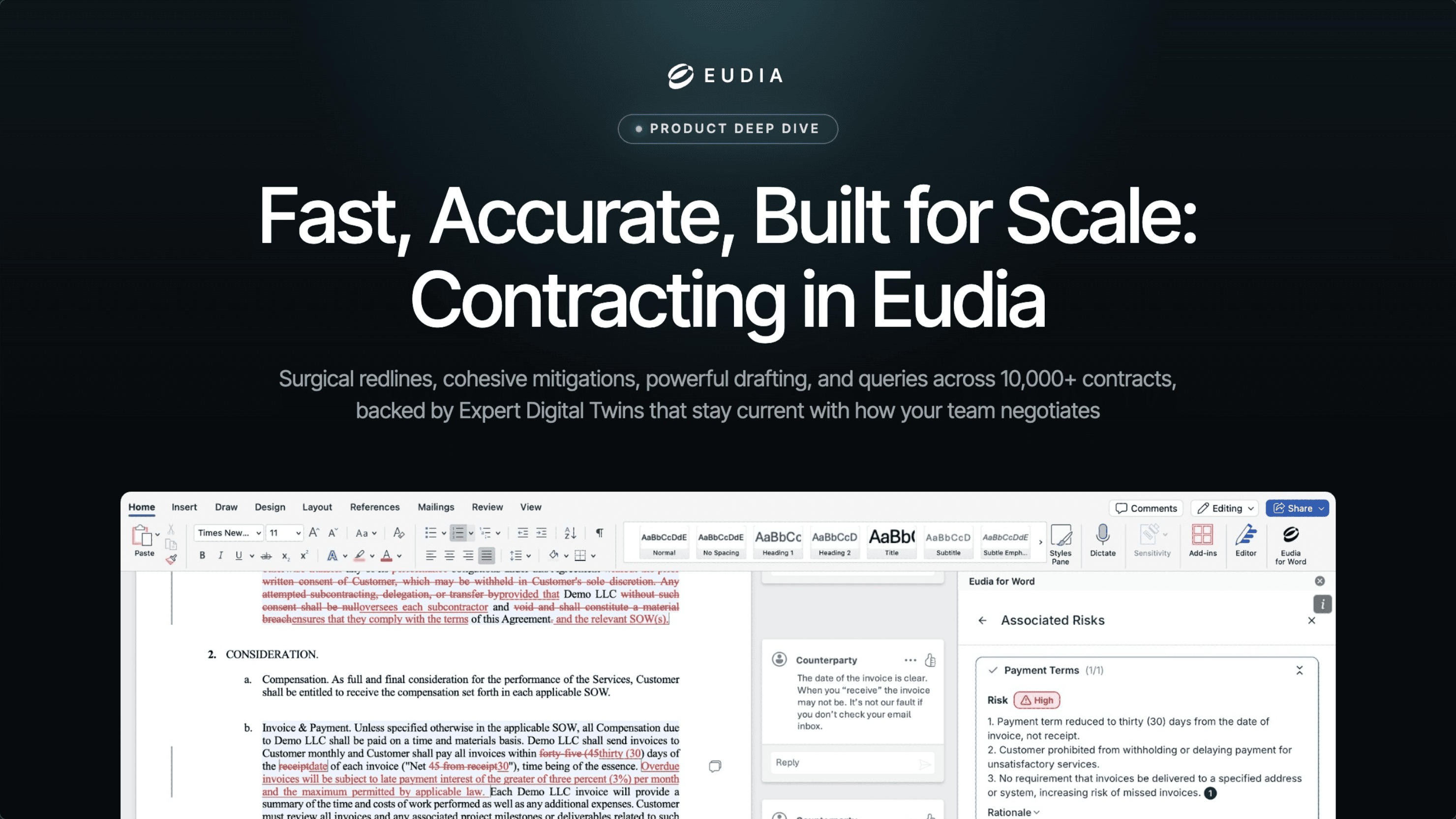
Eudia is built to return a markup a lawyer will recognize, because it looks like theirs. The edits are surgical and worked into the existing language instead of pasted on top of it, the comments stay short and persuasive, and the markup stays focused on the changes the transaction needs instead of drowning the lawyer in an ocean of edits with little bearing on the deal.

Review almost never ends on the first pass. The counterparty marks up your draft and sends it back, and this is the point where most tools quietly give up, telling you what changed and offering a list of ways you might respond before handing the real thinking back to you. Eudia handles the return the way an experienced member of your team would. It reads what the counterparty changed and why, checks the digital twin for how your business usually answers that kind of move, and drafts the responding redline and comment around your fallback positions. In the comment thread, it engages with the points the other side raised, explaining why your change is necessary instead of merely asserting it. Its opening recommendation to accept, reject, or modify the counterparty redline reflects how it reads the posture of the deal, but the final call stays with you. Additionally, your fallbacks are one click away in the options menu.

A twin is only worth having if it stays current, and currency is exactly where traditional playbooks fall apart. Priorities move, regulations change, a few hard negotiations shift the positions people are willing to take, and the document meant to capture all of it quietly goes out of date within a quarter or two. The usual remedy is a standing committee that gathers feedback, debates it, and circulates an update months later, by which point the standards have moved on again.
Eudia keeps the twin current through four routes, each designed for the scale of a large team rather than a single reviewer. A lawyer flags something in the moment, and the AI weighs that feedback before it proposes a change of its own. The AI also reads across the full history of reviews and redlines in the organization, notices how people are negotiating in practice rather than how the playbook says they should, and suggests adjustments grounded in real behavior. A user describes a new or changed rule in plain language, and the agent folds it in. Or someone hands the twin a fresh playbook or a set of gold-standard contracts and asks it to find where its existing rules and those documents disagree, then resolve the conflicts. Any one of these keeps the twin reasonably honest. Run together, they turn maintenance into something continuous and self-sustaining, so the twin tracks how the business is contracting across thousands of agreements and dozens of reviewers instead of freezing on the day it was built.

Risks handled cohesively so that redlines don’t open new gaps
Eudia separates the work into two stages, risk review first and redlining second, and the separation is a deliberate design choice rather than an extra hoop to clear. In the first stage, the platform surfaces each risk together with a proposed way to handle it, and it waits there for the lawyer. Pausing at that point does two things worth the moment it takes.
The first is discretion. Stopping on each risk forces the lawyer to engage with it and with the proposed strategy, and to make a real decision about whether a redline is warranted at all. Keeping a person in the loop here means the markup carries only the changes the deal needs, rather than every edit the model might propose.
The second is cohesion across the whole document. Because the mitigations stay in the queue until it is time to generate redlines, a risk that turns up in several places is handled consistently rather than piecemeal. A tool that works line by line, writing a redline the instant it spots an issue, has no way to hold a document together like this. It drops in cookie-cutter changes and leaves you to reconcile the contradictions.

Not every reviewer wants two stages. For them, Eudia offers an automatic pass, and what sets it apart from the usual apply-all button is the judgment behind it. Instead of dropping every suggested edit onto the page, a layer of intelligence first decides which risks are worth a redline, so what comes back reads like the reasoned markup a senior commercial lawyer would have produced on their own. A reviewer who wants speed gets a document worth signing off on, without being forced to choose between an overwhelming markup and a multi-step workflow.
First drafts that conform to your precedents
Drafting is where the distance between contract tools is widest. Most of them struggle to fill the blanks in a template from a reference document, and turning out a usable first draft is well beyond them. Eudia’s Word plug-in does both, and does them properly.
Given a blank page, it produces a draft that follows your own precedent while pulling the relevant terms and context out of one or more reference documents. Given a template with gaps, it fills the placeholders and the missing language from your precedent and reference material you provide instead of inventing something that merely sounds plausible. The same engine handles the drafting work teams normally reserve for their most senior people, whether that is an amendment to a live contract or a full amended-and-restated version of a signed agreement that absorbs and reconciles every prior amendment. Hours of careful assembly are completed in seconds, and the draft begins from your standards rather than a generic form pulled off a shelf.

Answers from every contract you have
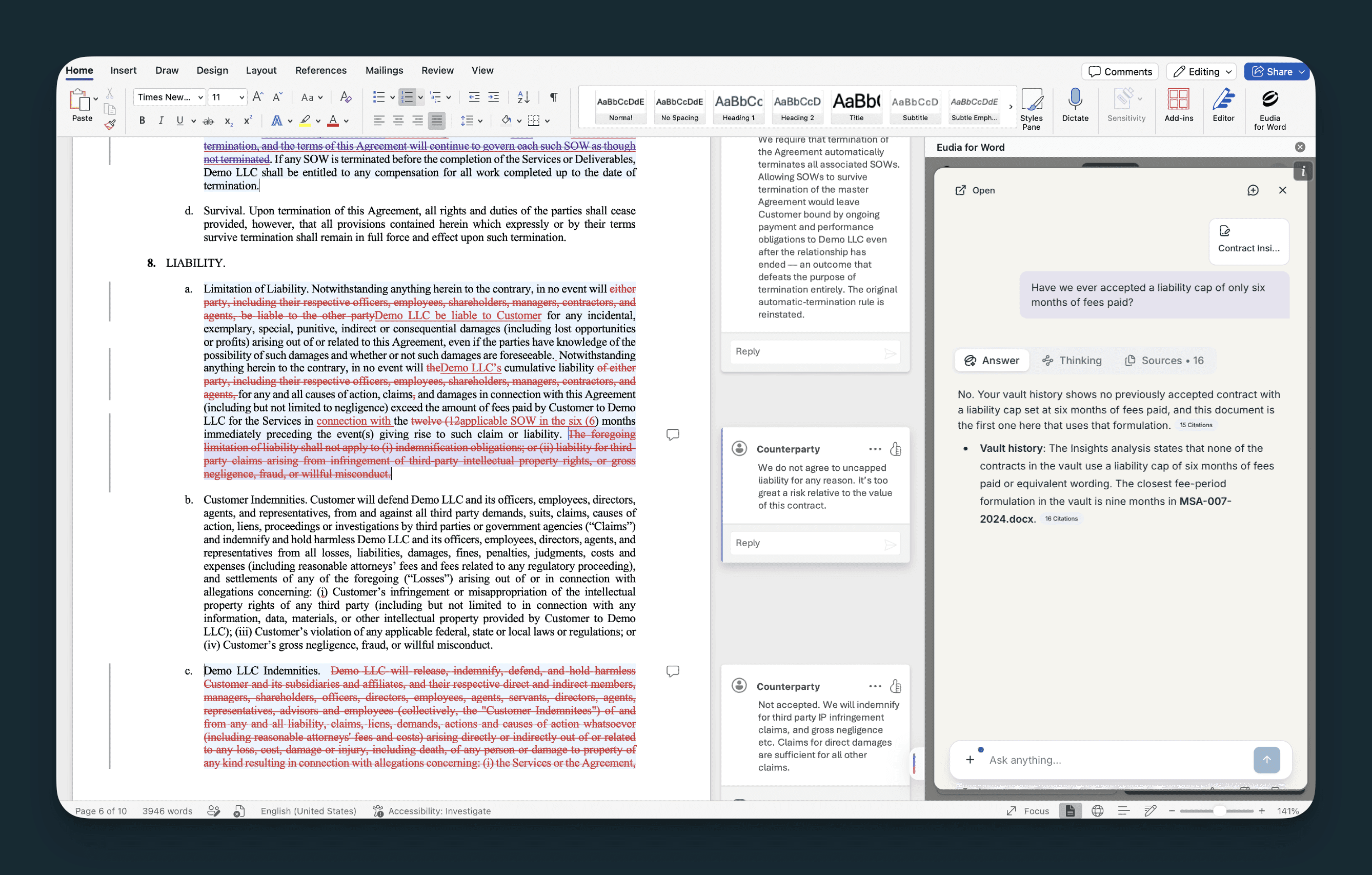
The intelligence sitting in your contracts is only as useful as the number of them you are able to interrogate at once. Many solutions cap out at around a few hundred documents, which is fine for one lawyer’s experiment and nowhere near enough for an enterprise. Eudia’s Insights runs plain-language queries across tens of thousands of records and returns answers that hold up, each one tied back to its source.
It will also take conditional logic in a single prompt, the kind of question real work throws up constantly. In the middle of a merger, for instance, you might need to know which of your vendor contracts require you to notify the counterparty before an assignment or transfer, which of those go further and require the counterparty’s consent, and which of the consent contracts carve out an exception when the transfer happens as part of a merger, acquisition, or similar corporate event. Most tools have no way to run a query with that many moving parts at all, let alone across an entire repository. And none of it calls for a migration. Eudia reaches into wherever your contracts already sit, whether that is SharePoint, Box, Ironclad, LinkSquares, another CLM, or some combination of them.
Setting the standard for contracting
Cargill is a useful picture of where the approach leads. Working with Eudia, the company turned its contract data into institutional intelligence, converting a store of signed agreements into something the business is able to question and learn from. The same logic carries across the platform. Handled properly, contracting captures the judgment of your best lawyers, puts it to work on every draft and every redline, keeps it current as the business moves, and lets it accumulate across the whole enterprise.
What you get from Eudia is drafting that starts from your own standards and redlines you would be comfortable putting your name on. On top of that, you are able to question every contract you hold and get a reliable answer back. That is the bar for AI-augmented contracting, and it is the one worth holding any tool to.